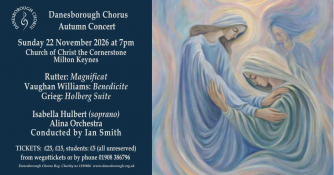
 Your events at Classical Events


Details
Church of Christ the Cornerstone
300 Saxon Gate
Milton Keynes
Buckinghamshire
MK9 2ES
England
Tickets
Prices: £25 ground floor, £15 balcony, Students £5
Booking line: 01908 386796
Book Tickets
Programme
John Rutter – Magnificat
Edvard Grieg – Holberg Suite, Op.40
Ralph Vaughan Williams – Benedicite
Performers
Isabella Hulbert – Soprano
Ian Smith – Conductor
Alina Orchestra
Danesborough Chorus
Programme Note
John Rutter: Magnificat
John Rutter’s Magnificat, first performed in 1990, is bright, rhythmic and uplifting. Inspired by vibrant festival celebrations in Spanish-speaking countries, it sparkles with energy and moments of calm reflection. Rutter was influenced by Bach’s setting, and although written more than 250 years apart, both works bring sacred texts to life with memorable melodies, expressive choral writing and a shared spirit of joy and praise. The work is full of energetic, syncopated rhythms and strong melodies, with more than a hint of musical theatre from time to time.
Rutter himself wrote: “I was conscious of following Bach’s example in adding to the liturgical text – with the lovely old English poem Of a Rose and the prayer Sancta Maria the last movement, both of which strengthen the Marian connection, and with the interpolated Sanctus in the third movement, which seems to grow out of the immediately preceding thought ‘et sanctum nomen’ (and holy is his name).”
Ralph Vaughan Williams: Benedicite
Benedicite was the largest and most complex of the three short works written by Vaughan Williams for the silver jubilee of the Leith Hill Musical Festival at Dorking in 1930. The festival was a competitive event designed to promote amateur choral singing to a high standard.
Benedicite is a canticle used in Catholic worship during the Liturgy of the Hours, reciting words from the ‘Song of the Three Holy Children’ (a text from the apocrypha). Vaughan Williams also uses lines from John Austin’s hymn ‘Hark my soul’.
Musically, the work has a very recognisable Vaughan Williams style, combining rich, full choral and orchestral sections with quieter, more reflective moments. At times, a soft soprano solo rises gently above the choir, creating a calm, flowing effect.
Edvard Grieg: Holberg Suite
Edvard Grieg wrote the Holberg Suite in 1884 to celebrate the 200th anniversary of the birth of Ludvig Holberg, a towering figure in Scandinavian literature. He first wrote it for piano, the instrument he knew best, but later arranged it for orchestra. Every section of the orchestra is given an important role, including solo parts for violin, viola and cello.
The overall sound of the suite is light, elegant and easy flowing, with five movements, each based on dance styles from the 18th century. The moods change throughout the piece – from the solemnity of the Sarabande to the carefree liveliness of Rigaudon (or Rigadoon).